After the 2026 Concours: A Few Numbers, Loose Ends, and What Comes Next
Our last post was published on 15 March, just before the CNRS auditions. More than five months have passed since then, which is certainly longer than we intended.
The explanation is not especially exciting: we were run over by work, life, and the concours itself. Writing about the process requires some headspace, and this spring we simply did not have much left. There is some irony in becoming too busy with the concours to maintain a blog about the concours, but that is more or less what happened.
With the summer holidays slowly coming to an end, and thoughts of the next campaign beginning to stir, this seems like a good moment to return.
A record year in numbers
The 2026 CNRS and CNAP concours both brought a striking increase in applications to the main astronomy and astrophysics competition. The table below follows the comparable figures published by SNCS-FSU for the CNRS concours specifically, as far back as they are available. The section was numbered Section 17 until 2025 and became Section 19 in 2026.
| Year | Candidates admis à concourir | Invited to audition | Open positions |
|---|---|---|---|
| 2022 | 169 | 44 | 5 |
| 2023 | 152 | 44 | 6 |
| 2024 | 209 | 39 | 6 |
| 2025 | 189 | 44 | 5 |
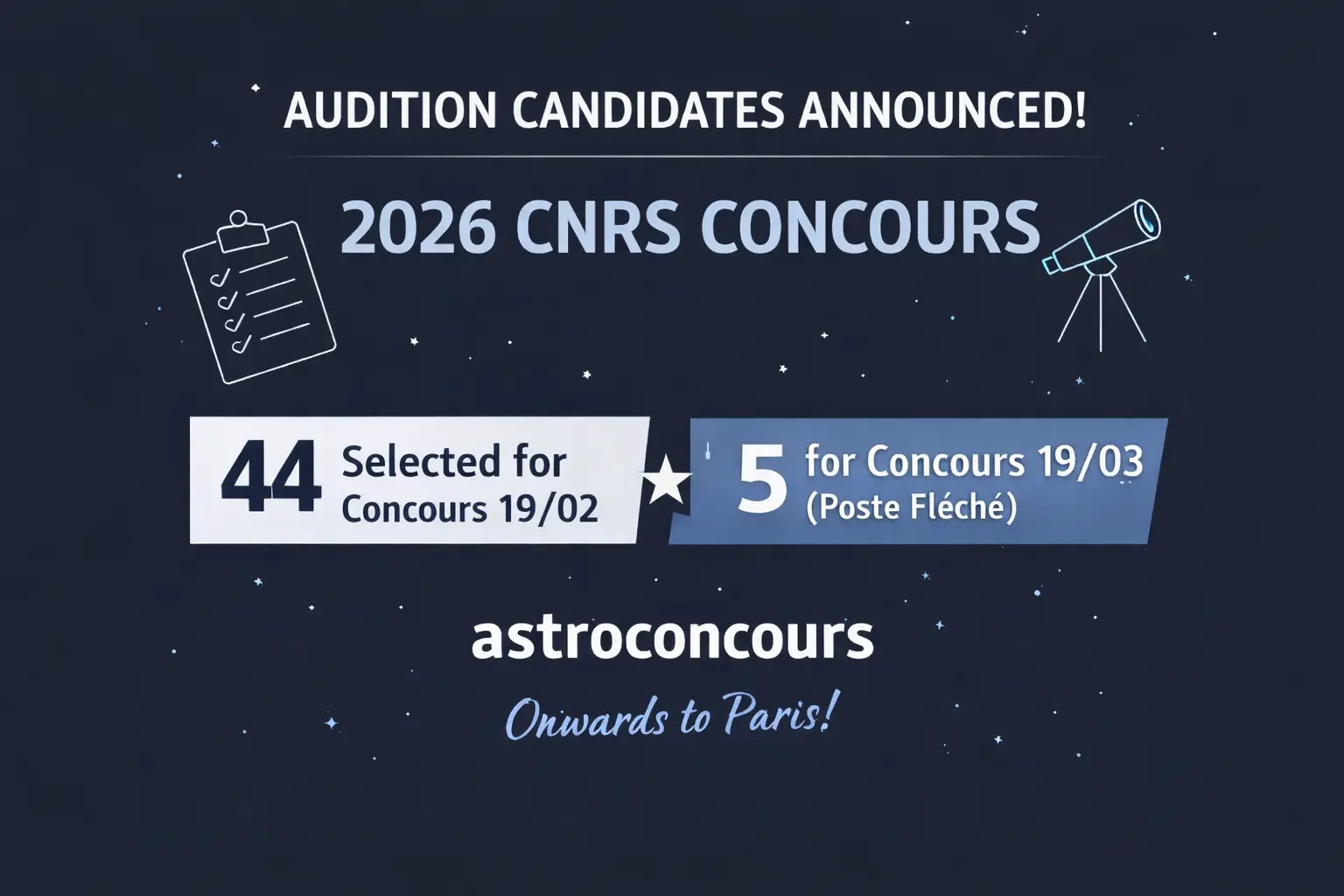
| 2026 | 237 | 44 | 5 |
Strictly speaking, these are candidates declared eligible to compete rather than the raw number of files submitted, but those are often the same except for a handful.
The jump from 189 candidates in 2025 to 237 in 2026 is an increase of roughly 25%, with the number of regular positions remaining unchanged. Only 44 candidates—about 19% of the field—were invited to audition. Put another way, there were more than 47 eligible candidates for each of the five positions.
This was not entirely isolated from what happened elsewhere. Application pressure rose across several European research programs this year. The European Commission reported a 65% year-on-year increase in applications to Marie Skłodowska-Curie postdoctoral fellowships, as well as a 130% increase in ERC Consolidator Grant applications from researchers based outside the EU and associated countries. These are not directly comparable to the CNRS concours, but they point towards a broader increase in the number of researchers looking towards European opportunities.
The numbers make the pressure on applicants very visible. An enormous amount of work went into dossiers that could not all pass the first selection, including many very strong ones. Reaching the audition stage in such a year was already a substantial achievement. Not reaching it should not be read as a simple verdict on the quality of a candidate or their science.
After the results: the administrative next steps
For the successful candidates, the publication of the final results is naturally a moment to celebrate. It is also the beginning of the less visible administrative work required to turn a concours result into an actual appointment.
We spoke with several people recruited both last year and this year, and it appears that the timing, or perhaps simply the route, of this process is not identical from one campaign to another. Last year, some candidates were asked to confirm their new positions by email and post around July. This year, some of the people we contacted had not yet received an equivalent request as of 28 August.
We do not know whether the procedure has formally changed, or whether there was never one completely fixed sequence in the first place. CNRS appointments involve several administrative levels, and there may be plenty happening behind the scenes that is not yet visible to the incoming researchers. Nothing in our conversations suggests a lack of goodwill: this seems much more like a large organization working through a complex appointment process.
Still, the uncertainty is understandably stressful. The default starting date of 1 October is now less than five weeks away. Depending on their situation, new recruits may need to move, find housing, complete visa formalities, give notice, or organize family arrangements. Even when the outcome of the concours is known, not knowing when the next instruction will arrive makes those preparations difficult.
We hope the remaining steps will become clear very soon. In the meantime, staying in contact with the future laboratory and the relevant CNRS administration on the level of the respective délégation régionale is probably the most useful course of action. We should also stress that our information here comes from a small number of personal conversations, not from an official overview of the 2026 appointment process.
Returning to the blog, a little differently
We hope to publish more regularly again, but probably not by following every stage of the concours calendar as closely as before. Much of the basic schedule remains similar from year to year, and repeating the same announcements does not necessarily add much once the information is already available on the blog and through official sources.
Instead, we want to concentrate on what has changed compared with recent campaigns and on parts of the process that we have not covered before. This should also make it easier for us to write when there is something useful to add, rather than trying to keep pace with every deadline while going through the concours ourselves.
For now, consider this a quiet reopening. Late August is not yet the moment to panic about the next campaign. Nobody needs to spend the final days of summer frantically reopening their Overleaf files. But some prospective candidates will slowly be asking themselves whether they plan to apply, what has changed since last year, and what they might want to approach differently.
We are beginning to think about those questions again too.
So, no, the blog is not dead. It was simply run over for a while by the very process it was created to document. Now we are picking it up again.